









文章来源:转载“大公报”
By reporter Mao Lijuan: On July 2, the three-day 9th Guangzhou International Refrigeration and HVAC Equipment Exhibition concluded at Zone C of the Canton Fair Complex. Mayer Technology, a subsidiary of Hong Kong-listed company Huiyuan Cowins (01116.HK), showcased its comprehensive PCM phase-change energy storage solution at Booth G23/25, demonstrating how innovative technology drives the industry's low-carbon transformation.
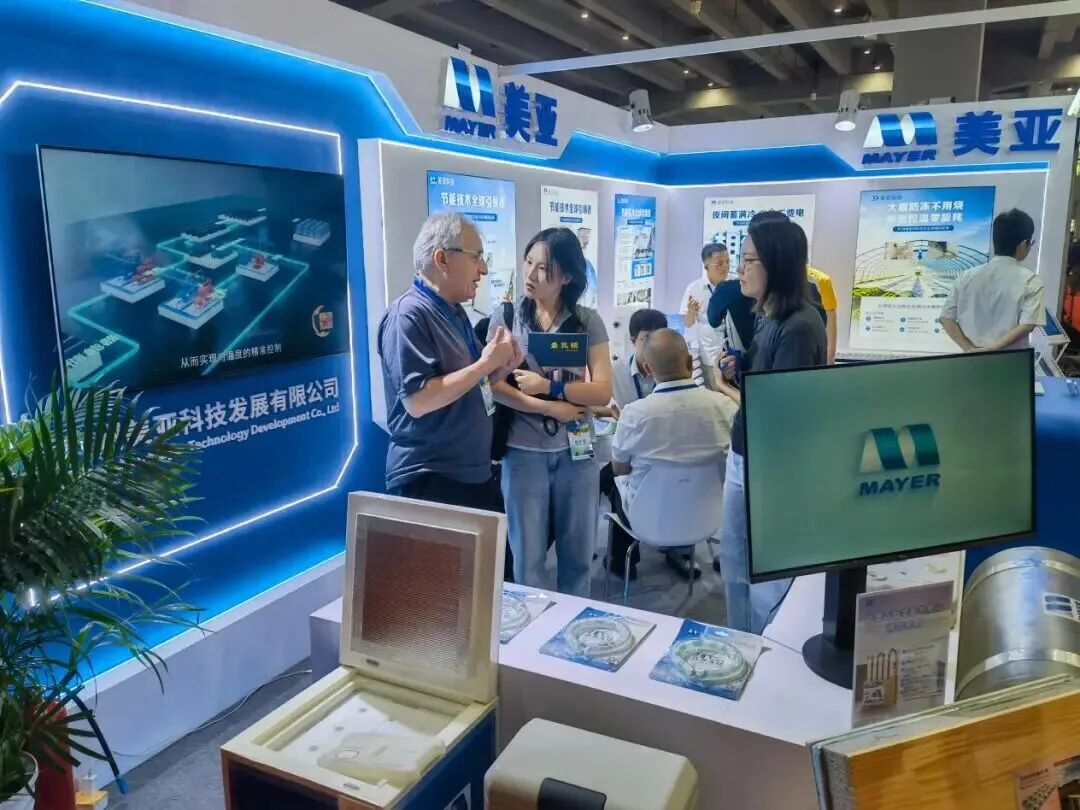
(美亚科技展区)
Driven by multiple policies including the dual-carbon strategy, the 15th Five-Year Plan for comprehensive energy development, and energy-saving upgrades in computing centers, cold chain facilities, and zero-carbon parks, the market size of phase-change energy storage materials as core solutions for thermal and cold energy storage continues to expand. However, the industry remains at a developmental stage characterized by mature laboratory technologies but systemic challenges in industrialization. Huiyuan Cowins has strategically positioned itself in the phase-change energy storage sector. Through its subsidiary Guangzhou Mayer Co., Ltd., it has established deep collaboration with EPS, a global leader in this field, which holds a 30% stake in Mayer Technology and provides core patented technologies covering the entire temperature range from-100°C to 1200°C, thereby pursuing an international development path through global technological synergy.
Guangzhou Mayer Co., Ltd., a core subsidiary of Huiyuan Cowins, was established in 1995 and has a history of 31 years, with a production base covering 55,000 square meters. It is China's first manufacturer with comprehensive production capabilities for inorganic phase-change materials, operating nine production lines with a minimum annual capacity of 20,000 tons per year.
Zhang Yana, Director of Huiyuan Cowins and General Manager of Guangzhou Mayer Co., Ltd., explained that the group has strategically entered the trillion-yuan phase-change energy storage sector after thorough feasibility studies. Leveraging the benefits of China's dual-carbon policies, the company targets a market where high-end full-temperature range phase-change materials—critical for zero-carbon industrial parks, computing centers, long-range cold chains, and modern agriculture—are in short supply, while industry prices remain stable and profit margins are substantial.
Our partner, UK-based EPS, is a global leader in phase change materials with 45 years of industry expertise, offering technologies applicable to four key sectors: central air conditioning, cold chain logistics, modern agriculture, and clean heating. Having established a strong presence in the domestic market for many years, EPS ultimately selected Mayer, recognizing its 31-year manufacturing heritage, comprehensive supply chain capabilities, and robust distribution network serving government and corporate clients. The British side aims to implement advanced PCM technology through this joint venture and leverage Mayer's production capacity to expand globally; Mayer possesses a mature in-house R&D system, enabling a synergistic integration of technology, production lines, and distribution channels between both parties.

(慧源同创董事、广州美亚股份总经理张雅娜)
When discussing the significance of this strategic cooperation, Zhang Yana summarized it as "laying the foundation for PCM new materials business, which will facilitate Mayer's transformation from a traditional manufacturing company into a technology enterprise." She noted that, on one hand, the group's existing traditional carbon steel and stainless steel businesses are developing steadily and sustainably; on the other hand, the group possesses a mature in-house R&D technology system. By establishing a joint venture with EPS, exclusively implementing this globally advanced phase-change core technology, and entering the billion-yuan energy storage sector, the group aims to create its second growth driver and achieve comprehensive development across multiple business areas.
For the entire industry, Mayer Technology positions itself as a leader in the phase-change materials sector. In collaboration with British partners, it actively participates in developing group standards and national standards, continuously refining domestic regulations for the phase-change energy storage industry. The company offers comprehensive localized carbon reduction solutions tailored for zero-carbon parks, computing centers, cold chain applications, and agricultural sectors, addressing gaps in China's advanced energy storage technologies, guiding the industry toward high-quality development, and supporting the implementation of the nation's dual-carbon strategy.

(EPS创始人Zafer Ure)
The EPS product line, with its patented technology covering the entire temperature range, establishes a competitive barrier and represents the group's second source of growth
As the pioneer in the global phase-change materials field and a leading international provider of phase-change energy storage technology, EPS has implemented its core technologies across four major application sectors—including central air conditioning, cold chain logistics, modern agriculture, and free heating systems—establishing a comprehensive technological portfolio spanning from cooling to heating applications. Its technical advantages are particularly evident in "full temperature range coverage," extending from extreme low temperatures (-100°C) to high temperatures of 1200°C, far exceeding the conventional 0°C–80°C limitations of most domestic companies.
Zafer Ure, founder of EPS, revealed in an interview that after extensive validation across various global scenarios, EPS's technical capabilities have been implemented in multiple benchmark projects: for instance, in public healthcare and government institutions, the 45 m³ tank (with 2000 kWh energy storage capacity) at the Netherlands Cancer Institute leverages nighttime low electricity prices to reduce research costs; in the industrial production sector, the project by China Tobacco Mauduit (Jiangmen) Paper Industry Company ltd. achieves precise alignment between the cooling capacity of chillers and actual workshop demands through real-time adjustment, ensuring continuous efficient operation of the cooling systems. Additionally, by integrating with grid-based peak-shaving and load balancing strategies, these solutions not only lower operational costs but also promote energy conservation and emission reduction, providing an effective solution for maintaining constant temperature and humidity in industrial workshops.
In Zafer Ure's view, the core rationale behind EPS choosing Mayer Technology as a strategic partner lies in its localized advantages: on one hand, Mayer boasts a stable customer base in the traditional materials processing sector and has established close collaborations with official institutions such as China's Ministry of Agriculture and Rural Affairs Engineering Construction Service Center and data center operators, enabling rapid technology implementation; on the other hand, its end-to-end delivery capabilities and large-scale production capacity are expected to provide robust support for cost control.
Reforming the logic of industrial competition and establishing a triple moat defense system
By combining EPS's world-leading technology with Mayer's local full-industry-chain resources, the joint venture aims to establish three distinct and hard-to-replicate competitive advantages: First, a technological barrier – global leadership in technical capabilities coupled with integrated delivery capacity and extensive demonstration projects worldwide; Second, a policy barrier – dual qualifications as a Hong Kong-listed entity and an international sci-tech innovation partner, enabling priority access to national subsidies and industrial support policies for zero-carbon park upgrades, industrial energy efficiency initiatives, and green manufacturing programs; Third, a standardization barrier – both Chinese and British parties hold multiple proprietary invention patents, leading the development of specialized technical specifications for energy storage applications in zero-carbon parks and securing a dominant position in industry standard-setting.
Zhang Yana explained that the joint venture's production capacity planning will be implemented in two phases: the first-phase PCM phase-change material production line commenced operations in 2023 with an annual capacity of 20,000 tons; the second phase will be expanded opportunistically based on growth in energy-saving retrofit orders both domestically and internationally.
In terms of corporate performance, by 2026, the joint venture's phase-change energy storage and zero-carbon comprehensive transformation businesses will gradually generate revenue; by 2027, full production capacity across the entire line will be achieved. Zhang Yana noted that the gross margin in the phase-change energy storage segment is significantly higher than that of traditional carbon steel and stainless steel pipeline businesses. As the revenue share from high-margin segments continues to rise, the group's overall profit structure will further improve, and it will benefit substantially from national-level policy incentives such as those related to carbon peaking and carbon neutrality goals and zero-carbon industrial parks. For Huiyuan Cowins, this collaboration represents a pivotal step in its strategic transformation.
Through its 2025 Global Strategy Brand Upgrade, focusing on smart energy storage technology and establishing joint ventures to drive technological industrialization, the company has successfully transformed from a traditional steel enterprise into a green technology group. As the share of revenue from energy storage business grows, its valuation logic is expected to shift from manufacturing PE to new energy PS, unlocking significant growth potential for market capitalization.
Focusing on four high-potential sectors, policy incentives are unlocking a market potential worth hundreds of billions
The business sectors targeted by EPS and Huiyuan Cowins align precisely with China's "dual carbon" goals and the policy direction of the energy storage industry. The 15th Five-Year Plan has unleashed a comprehensive energy investment scale of 2 trillion yuan, while the demand for zero-carbon park upgrades continues to grow across regions. Among these, four segments—zero-carbon parks, AI computing centers, long-term cold chains, and facility agriculture—are experiencing the fastest demand growth, making them natural priorities for the joint venture established by both parties.
Zhang Yana revealed that the demand in the phase-change energy storage sector exhibits distinct structural explosive growth characteristics. In the application field of AI computing power centers, energy consumption continues to rise sharply alongside surging computational demands. Data from IDC's "2025 China Data Center Green Industry White Paper" indicates that the market size for green/low-energy-data centers will exceed 200 billion yuan by 2025, with an annual growth rate of over 18%. Although energy efficiency has continued to improve (with average PUE falling below 1.3), overall electricity consumption remains on a high growth trajectory, directly driving the accelerated expansion of the waste heat recovery market. Boyan Consulting predicts that the specialized waste heat recovery market for data centers is expected to surpass 4 billion yuan by 2026, while the overall industrial waste heat recovery market is projected to reach a scale of 200 billion yuan.
According to data from the "2026 White Paper on Intelligent Transformation of Facility Agriculture" released by the China Agricultural Machinery Circulation Association, the total area of facility agriculture in China is approximately 42 million mu, with an intelligent transformation penetration rate of about 32%. By 2026, the combined efforts of upgrading existing greenhouses with smart technologies and constructing new intelligent greenhouses are expected to drive market growth, with the overall scale of the intelligent facility agriculture market projected to exceed 100 billion yuan, reaching a median value of 102 billion yuan.
The market for energy-saving renovations of commercial buildings is also experiencing rapid expansion. According to official estimates in the "Building Energy Efficiency Industry White Paper 2025" by the China Building Energy Efficiency Association, the overall market size for building energy efficiency is expected to reach approximately 900 billion yuan in 2026 and is projected to exceed 1.2–1.5 trillion yuan by 2030, with an average annual growth rate of 12%–15%. Furthermore, the deepening reform of the electricity market has widened the peak-to-off-peak price differential to over 4:1, significantly enhancing the economic viability and adoption rate of energy storage technologies. These multiple demands have created a synergistic effect, collectively opening up vast growth potential for the smart energy storage sector.
It is worth noting that this collaboration has established a comprehensive and actionable roadmap for Huiyuan Cowins's global expansion: leveraging its domestic production base in Mayer as the group's unified global supply hub to undertake zero-carbon retrofitting projects and thermal energy storage solutions for high-temperature regions worldwide, while providing phase-change cold storage systems and integrated industrial energy-saving solutions internationally. This signifies that the joint venture will progressively develop a business model combining "local production with global sales," thereby unlocking further growth potential.
Zafer Ure revealed that the quality standards for all products manufactured by the joint venture will be consistent with those of its UK-based factories. In the future, the joint venture will export high-quality products to regions such as the Middle East, Far East, Australia, and Japan via its Guangzhou base, leveraging the advantages of China's more efficient logistics and trade processes. As a result, it is expected to handle a significant volume of export orders, thereby expanding the global business footprint of Huiyuan Cowins and EPS, and laying a solid foundation for the long-term growth of the joint venture.
A recent example that has drawn global attention is how the normalization of extreme summer heatwaves in Europe has directly driven demand for energy-saving temperature control products from China. Huiyuan Tongchu operates a business network covering all five continents and boasts established overseas distribution channels. The group adopts a model combining "mass production at its domestic facilities with global channel distribution," actively participating in zero-carbon transformation projects in high-temperature regions of the Middle East. All revenue from exports of phase-change cold storage systems and comprehensive industrial energy-saving solutions will be incorporated into the listed company's financial statements, achieving simultaneous growth in both domestic and international markets and expanding the group's performance growth potential in both directions.

 Official WeChat
 Service Hotline
 Mayer Stainless Steel Pipe Website
 Carbon Steel Processing Website